
Does schema markup help AI search? What the evidence says
By Mohamed Hadri
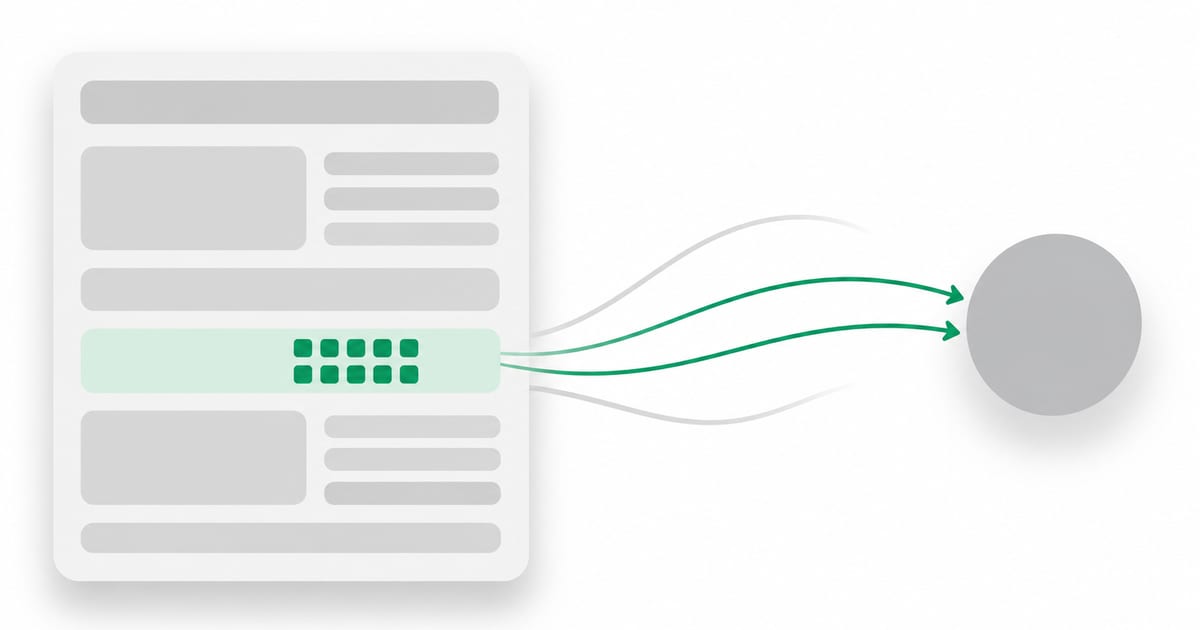
Does schema markup help AI search? Not the way it’s often sold: no test we found shows it getting a site into ChatGPT or Google’s AI answers. Google says its AI features need no special schema, and in the largest controlled test we found, Ahrefs saw no citation lift when already-cited pages added JSON-LD. Accurate schema still earns its place, mostly in ordinary Google results.
Check these, in order:
- Can AI search bots reach and read your page? Start here: schema can’t help a page a bot never gets, or markup it never sees. Our free scan checks your home page.
- Are your key facts (what you sell, where, prices, hours) in the page’s visible text?
- Is your schema in the page’s HTML, free of errors, and true to what the page shows?
- Measure before you pay anyone for more.
Does schema markup help AI search? What Google, Microsoft and OpenAI say
None of them says schema gets you into AI answers; only Microsoft says it may help. As of 3 November 2026:
| Company | What its pages say |
|---|---|
| Structured data isn’t required for generative AI search, and there’s no special schema.org markup to add. It still helps with rich results (the enhanced listings in normal search), and it should match the visible text. | |
| Microsoft (Bing, Copilot) | Bing’s guidelines: structured data “may support clearer grounding” (the sources an AI answer is built on) but doesn’t guarantee visibility. A Microsoft Advertising post says schema helps AI systems understand content. |
| OpenAI (ChatGPT) | Its crawler page doesn’t mention schema. For shopping, merchants share a product feed. |
| Perplexity, Anthropic (Claude) | Their crawler pages (Perplexity, Anthropic) don’t mention schema. |
Google even lists “overfocusing on structured data” among things you can ignore. On llms.txt, see does llms.txt actually work?
What do the tests show?
None of them shows schema alone getting a page cited, and they don’t even agree on whether AI tools read JSON-LD.
- Ahrefs (May 2026) tracked 1,885 pages that added JSON-LD, against matched controls. ChatGPT (+2.2%) and AI Mode (+2.4%) citations moved by amounts it calls statistically indistinguishable from zero; AI Overview citations fell 4.6%, a small but statistically significant drop it says it can’t pin on schema. But every page already had 100+ AI Overview citations, so the study can’t speak for pages AI doesn’t see yet.
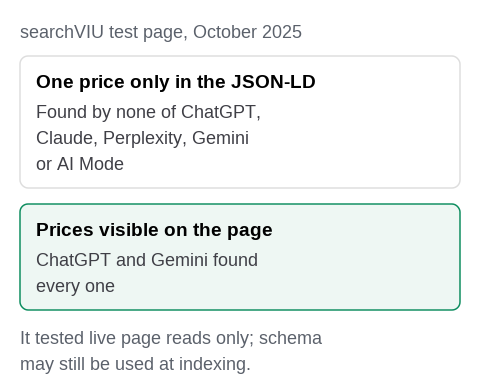
- On a searchVIU test page (October 2025), one price sat only in the JSON-LD. None of ChatGPT, Claude, Perplexity, Gemini or AI Mode found it, while ChatGPT and Gemini found every visible price. It tested live page reads only; schema may still be used at indexing.
- Otterly asked seven AI tools to fetch the markup on its own site, and only Gemini fetched it correctly. From December 2025 to March 2026 it saw no measurable citation effect on most platforms.
Be wary of big multipliers from sellers with no control group. Otterly itself credits the 1,500% rise in AI Overviews citations on its own site to classic SEO, not to schema.
Do AI tools read your schema instead of your text?
No test we found shows that. The claims that AI “reads entities, not text” or always trusts JSON-LD over the page come without one, and searchVIU’s price test points the other way. Google’s guidelines say don’t mark up content readers can’t see, and Bing says markup must reflect visible content.
Put every fact you care about in the page text and let schema repeat it. Picture a Riyadh perfume shop with “from 250 SAR” only in its Offer markup, or a Dubai clinic with its Ramadan hours only in LocalBusiness code: a tool reading the text misses both.
What does schema markup help with, then?
Mostly Google’s ordinary results, and telling Google who you are. The types most owners need:
- Organization, on your home page. It helps Google understand your administrative details and tell you apart from others.
- LocalBusiness, which can tell Google your hours and departments. Keep it in line with your Google Business Profile (see AI giving wrong information about your business).
- Product with its offer, so results can show price, availability and review ratings.
- FAQPage: Google’s FAQ rich result stopped appearing from 7 May 2026. Leave the markup if your platform adds it free and the questions show on the page, but don’t pay for it as an AI lever.
Misleading markup can cost a page its rich results through a manual action, which Google says doesn’t affect how the page ranks. Our free schema generator writes Organization, LocalBusiness, FAQ or Article JSON-LD.
Is your schema actually in the page AI bots read?
Maybe not, if a tag manager, theme script or app adds it after the page loads. Google processes structured data that JavaScript adds. Other bots may not: in a December 2024 Vercel study, no major AI crawler it measured, OAI-SearchBot, ClaudeBot and PerplexityBot among them, rendered JavaScript. That may have changed since.
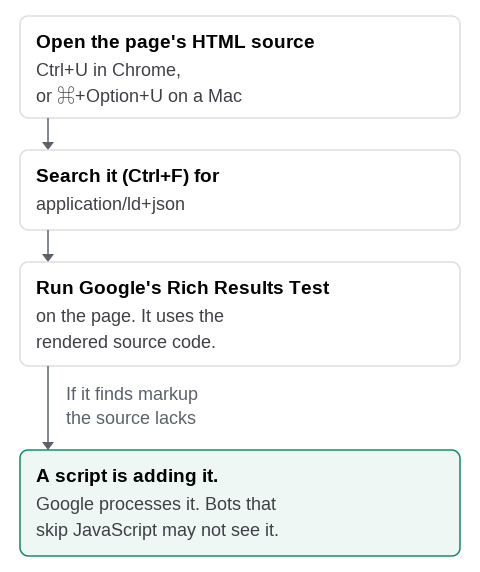
Markup can also vanish unnoticed: Google warns pages might break after deployment, and a new theme or removed app can take its markup with it. To check by hand:
- Press Ctrl+U in Chrome (⌘+Option+U on a Mac) to see a page’s HTML source, then search it (Ctrl+F) for
application/ld+json. - Run the page through Google’s Rich Results Test, which uses the rendered source code. If it finds markup the source lacks, a script is adding it.
To check your home page in one go, run our free scan. It reads the HTML your server sends without running JavaScript, much as a bot that skips scripts would. It reports whether it found structured data or Organization markup (and flags JSON-LD it couldn’t read when no valid block is present), and whether bots can get in.
Without an account you see a score out of 100 and each check’s status, names blurred. Which check is which, what we found (in Arabic) and the general fixes open free once you add the site to your account. The scan doesn’t check product pages, rich result requirements, whether markup matches your text, or whether AI tools cite you.
Does Salla, Zid, Shopify or WordPress already add schema?
Some do, so check before paying someone to add it again.
- Shopify: themes can output Product (or ProductGroup) and Article markup with one filter,
{{ product | structured_data }}. A product page’s source shows whether yours does. - Salla: its help centre shows how to add schema through Google Tag Manager, which adds it with JavaScript. Google reads that; bots that skip JavaScript may not. We found no Salla page listing its default markup.
- Zid: we found no Zid page saying what it adds.
- WordPress: Yoast says it adds schema automatically as JSON-LD, and Rank Math says it supports schema out of the box.
Added schema and still not showing up? What to check next
Check what decides whether you can be cited at all:
- Access: robots.txt, your firewall and noindex. See why ChatGPT can’t see your website and which AI bots to block.
- Visible facts on the pages that answer buyers’ questions: prices, areas served, delivery, hours.
- Whether you rank, and whether others talk about you. Google’s AI features can show what’s being said about products and services across the web, including blogs, videos and forums. Your own site still counts: if bots can’t get in, or your facts need JavaScript, AI tools have nothing of yours to quote.
- Measurement: Search Console’s Generative AI performance report, which counts AI Overviews and AI Mode impressions; the reports in is AI search sending you visitors?; and our AI visibility checker, which asks an AI engine one real buyer question.
What should you ask before you pay for schema “for AI”?
Ask the freelancer or agency four things:
- Which types will you add, and which visible content does each one describe?
- Will the markup be in the page HTML, or added by a script or tag manager?
- Will it pass the Rich Results Test and match what the page shows?
- How will we measure? Agree on a before and after: that Search Console report, plus the same buyer questions asked in AI tools by hand each month.
Walk away from anyone who guarantees a citation, or sells a special “AI schema” or a secret file. Google says no third-party tool has access to its internal ranking or AI systems. Our free GEO checklist covers the other basics.
Sources
- Google Search Central: Google’s Guide to Optimizing for Generative AI Features on Google Search · updated 10 July 2026
- Google Search Central: AI Features and Your Website · updated 10 December 2025
- Google Search Central: General Structured Data Guidelines · updated 10 July 2026
- Google Search Central: Structured Data Markup that Google Search Supports · updated 16 October 2026
- Google Search Central: Organization Schema Markup · updated 8 September 2026
- Google Search Central: Local Business (LocalBusiness) Structured Data · updated 8 September 2026
- Google Search Central: Generate Structured Data with JavaScript · updated 10 December 2025
- Google Search Central: Intro to How Structured Data Markup Works · updated 10 December 2025
- Google Search Central: Latest Google Search Documentation Updates · updated 26 October 2026
- Search Console Help: Rich Results Test
- Search Console Help: Generative AI performance report (Search)
- Google Chrome Help: Chrome keyboard shortcuts
- Bing Webmaster Tools: Webmaster Guidelines
- Microsoft Advertising: Optimizing Your Content for Inclusion in AI Search Answers · 8 October 2025
- OpenAI: Overview of OpenAI Crawlers
- OpenAI: Power product discovery in ChatGPT
- Perplexity: Perplexity Crawlers
- Anthropic: Does Anthropic crawl data from the web, and how can site owners block the crawler? · 7 April 2026
- Ahrefs (third party): We Tracked 1,885 Pages Adding Schema. AI Citations Barely Moved. · 11 May 2026
- searchVIU (third party): Schema Markup and AI in 2025: What ChatGPT, Claude, Perplexity & Gemini Really See · 2 December 2025
- OtterlyAI (third party): GEO Experiment: Does Schema Markup Really Impact AI Search? · updated 23 March 2026
- Vercel (third party): The rise of the AI crawler · 17 December 2024
- Shopify developer docs: Liquid filters: structured_data
- مركز مساعدة سلة: ساعد محركات البحث على فهم محتوى متجرك بواسطة Schema markup · updated 19 August 2026
- Yoast: Structured data (Yoast SEO features)
- Rank Math: Configuring “Schema Markup” in Rank Math for Rich Snippets